



Hello, everyone. I’m Dr. Chu Hsin-Cheng, a specialist in male enhancement and girth-increase surgery.
In fact, many people’s penises aren’t perfectly straight. It’s very common for them to curve to the left, right, upward, or downward.
There’s even a saying that an upward-curving penis is the ultimate prize, because the angle can better stimulate the G-spot or prostate in certain positions. Some people with straight penises even specifically want theirs to curve to improve their sexual performance.
But some people are born with a pronounced curve, or their penis becomes curved later in life due to an injury, impact, or tug that damages the tunica albuginea. This can affect not only penetration, but also appearance and self-confidence.
In that case, it’s time to see a doctor for an evaluation and find out whether corrective surgery is needed.
Understanding the Corpora Cavernosa and Tunica Albuginea
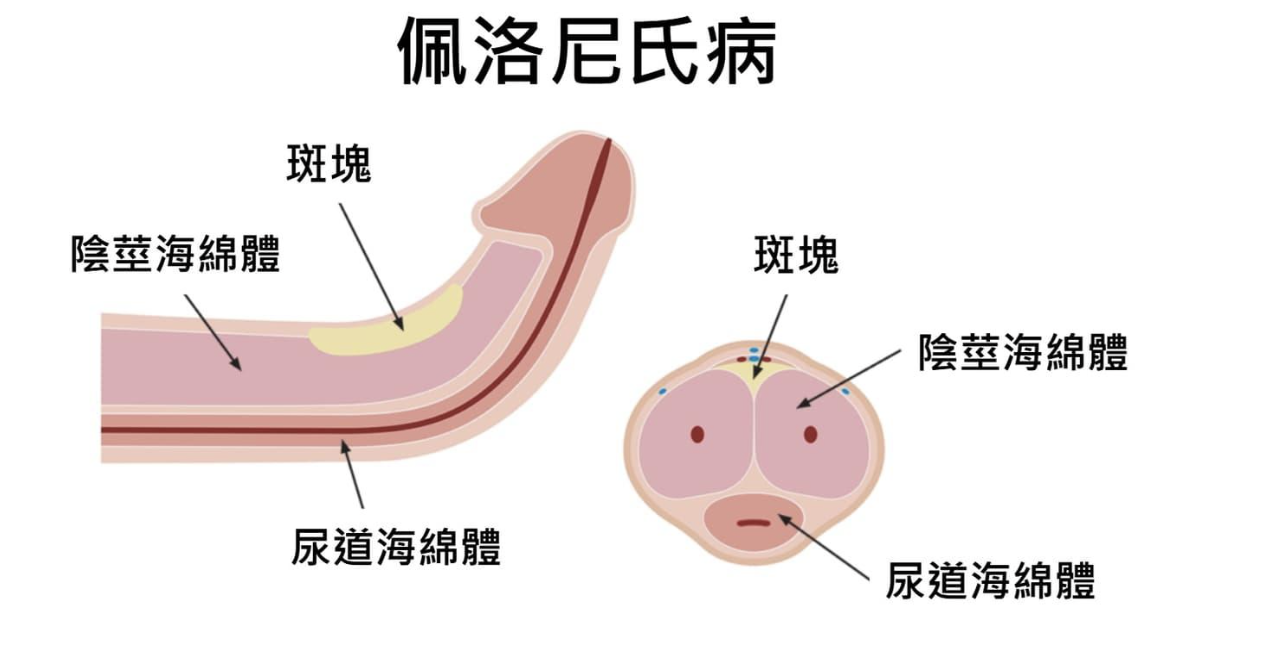
To understand why a penis curves, let’s first take a look at its internal structures:
-
Corpora cavernosa (two): Primarily responsible for erection firmness
-
Tunica albuginea: Encloses the two corpora cavernosa and maintains their shape; its strength is similar to a rubber band
-
Corpus spongiosum (one): Surrounds the urethra and forms the glans at its tip
Penile curvature is often related to a deformity in the tunica albuginea or uneven tension on it.
How Do You Measure the Angle of Penile Curvature?
To find out how much your penis curves, measuring the angle is key!
The method is simple. Just follow these three steps:
1. Get a full erection
Measurements taken when you’re only partially erect or fluctuating between hard and soft won’t be accurate. Your penis must be fully erect when you take photos or observe it.
2. Take dick pics
Take one photo from above, then another from the side.
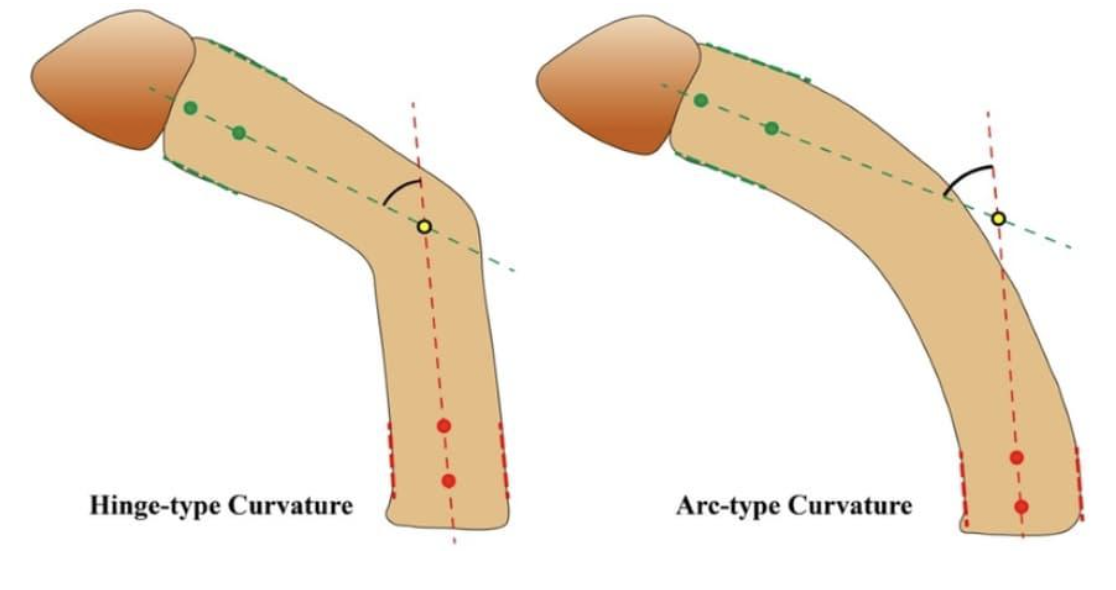
Find the “axis” of your penis
Imagine your penis as a straight rod.
Draw two axis lines from the base to the tip of the glans (the front half and the back half).
The curve is usually where the axis changes direction, around the middle.
3. Analyze it with an app or a photo
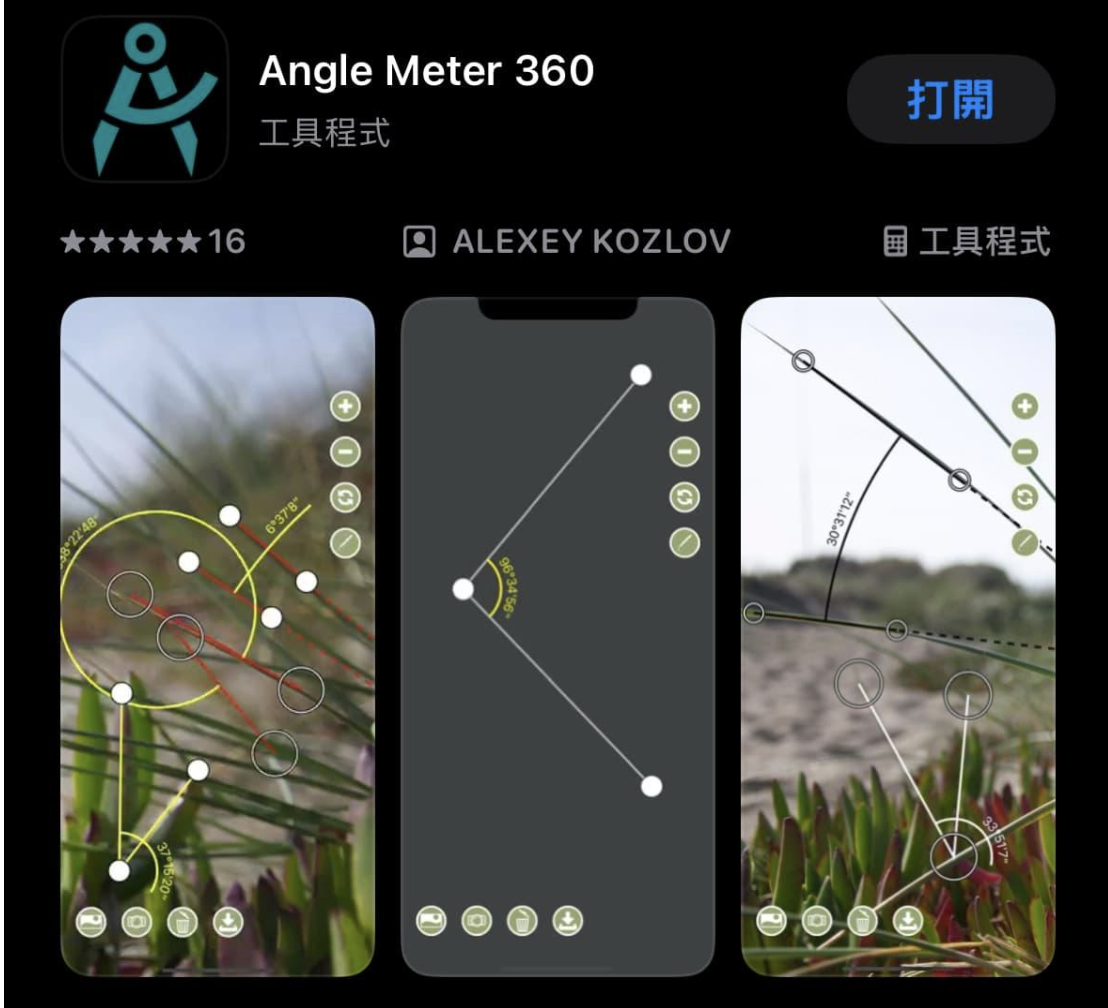
You can use “Angle Meter 360” (available for iOS and Android).
The angle between the two axis lines is the angle of your penile curvature.
Highly recommended—free and easy to use.
How Much Curvature Counts as Curved?
A slight curve is perfectly normal. In most cases, a curve of less than 20–30 degrees doesn’t significantly affect sexual activity.
But if the curve is too pronounced, you may experience the following:
-
Difficulty with penetration
-
Sex feels awkward
-
Thrusting may cause discomfort for your partner
-
You may also experience pain or difficulty getting a full erection
Does Your Penis Feel Lumpy? What Is Peyronie’s Disease?
If you notice that your penis curves unnaturally, has a lump, or even hurts when erect, you may have Peyronie’s disease.
There are many possible causes:
-
Vigorous masturbation
-
Rough sex
-
A strain or tear in the tunica albuginea
-
Or chronic inflammation with no known cause
After an injury to the tunica albuginea, plaques can form. These plaques may harden and calcify, making one side of the penis less flexible and causing it to curve. They may even affect erection firmness.
How Is Peyronie’s Disease Treated?
1. Conservative treatment
Monitor the condition for 3–12 months during the acute phase.
Use oral medication to control inflammation and fibrosis.
2. Minimally invasive treatment
Low-intensity shockwave therapy + PRP growth factor injections
May soften plaques and improve pain and curvature.
3. Surgery
If the first two approaches don’t work, corrective surgery may be considered.
What Types of Penile Curvature Correction Surgery Are There?
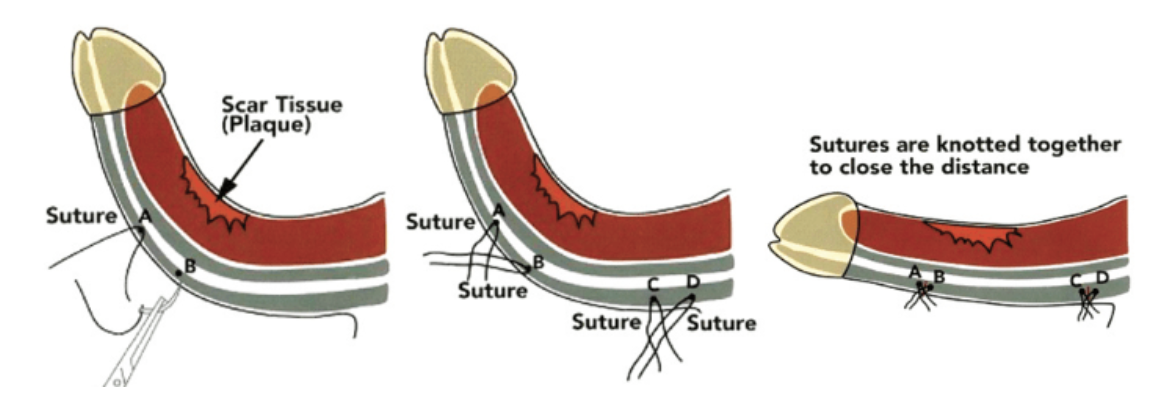
1. Tunical plication
This is the most common corrective procedure. The tunica albuginea on the longer side is folded and stitched, according to the direction of the curve, to straighten the penis.
Advantages: Erection firmness remains unchanged, it is less invasive, and recovery is faster. Suitable for penises with less complex curvature.
Disadvantages: The erect penis may be shorter, and you may be able to feel the knots in the sutures.
2. Short-side tunical lengthening (graft repair) In simple terms, it’s like taking from one place to make up for what’s missing in another.
Suitable for people with a severe curve or more complex deformity.
The “short side” of the tunica albuginea is cut and lengthened, then repaired with a graft (commonly a vein from the thigh or fascia).
Advantages: Preserves the most length.
Disadvantages: The procedure is technically challenging, requires an additional incision in the thigh, and may somewhat reduce erection firmness.
3. Penile implant
Suitable for patients with severe erectile dysfunction and curvature who cannot get an erection firm enough.
It is performed together with tunical lengthening, providing a definitive solution to both length and firmness issues.
Advantages: Increases erect length, and the penile implant ensures firmness. You won’t have to worry about firmness or length anymore.
Disadvantages: More invasive, higher risk of infection, and expensive.
How Long Is the Recovery Period?
Recovery time varies depending on the type of surgery:
Simple plication: Resume daily activities in 1–3 days; resume sexual activity in 4–6 weeks.
Grafting / penile implant: Resume daily activities in 3–5 days; resume sexual activity in 4–6 weeks.
Avoid sexual activity and excessive erections during recovery to give the tunica albuginea time to heal.
How Much Does Surgery Cost?
The cost of surgery varies depending on the type and complexity of the procedure, the surgeon’s experience, the facility, and other factors:
Tunical plication: NT$50,000–150,000
Short-side tunical lengthening with or without grafting: NT$50,000–150,000
Penile implant: NT$250,000–500,000 (depending on brand and specifications)
Can a Straight Penis Be Made to Curve Upward? The So-Called “Dragon-Raising-Head” Surgery
Someone once asked me, “Doctor, I’d like my penis to curve upward a bit so sex feels more stimulating. Can that be done?”
The answer is: In theory, yes. But before proceeding, a thorough evaluation is essential. This “Dragon-Raising-Head” surgery isn’t suitable for everyone.
That reminds me of an episode of *The Chinese Chef* featuring “Rising Dragon Dumplings.” The dumplings curved upward like a rising dragon because the two types of wrappers puffed up at different rates.
The principle behind Dragon-Raising-Head surgery is similar.
A suture is used to create a small, “controlled restriction” on the dorsal (upper) side of the penis. This allows the ventral (lower) corpus cavernosum to expand more during an erection, creating a natural upward curve—hence the name “Dragon-Raising-Head surgery.”
Which Surgery Is Right for Me?
Every penis is different in its curvature, erection firmness, and plaque location. There is no one-size-fits-all solution.
Here’s a simple reference guide:
Prioritize firmness → Tunical plication
Complex curvature → Short-side tunical lengthening + grafting
Complex curvature and poor erection firmness → Tunical lengthening + penile implant
Sufficient budget → Penile implant or advanced combination procedure
Want an upward curve → Tunical plication (Dragon-Raising-Head surgery)
Before surgery, take one photo of your erect penis from the front and one from the side.
And be sure to discuss the following with your doctor:
How firm are your erections?
Does your partner experience discomfort?
What are you hoping to improve: appearance, function, or confidence?
Your sexual habits and expectations?
That way, you can achieve the “Dragon-Raising-Head” result you’re hoping for after surgery!

本文醫療審訂
Dr. Chu Hsin-Cheng
Dr. Chu Hsin Cheng
A urologist specializing in male intimate aesthetic surgery and the diagnosis and treatment of sexual dysfunction. With over 10 years of clinical experience, he is committed to supporting every man with evidence-based, easy-to-understand health education. Professional, compassionate, and discreet—helping you regain your confidence.