



“When I masturbate, I ejaculate in just 2–3 minutes. With my girlfriend, I can last at most 3–5 minutes. Doctor, does this count as premature ejaculation? What should I do?”
— The first thing a 22-year-old university graduate said to me when he came to the clinic
Today, we’re not discussing myths or selling folk remedies
We’ll simply help you understand the definition of premature ejaculation and exactly how it can be treated


What is premature ejaculation? Is it a disease?
Not necessarily. Medically, “premature ejaculation” is defined by the following characteristics:
●Lifelong premature ejaculation: ejaculation almost always occurs before penetration or within about “1 minute” after penetration
●Acquired premature ejaculation: ejaculation almost always occurs before penetration or within about “3 minutes” after penetration
●Always or almost always unable to delay ejaculation
●Causes negative emotional or psychological effects, such as distress, worry, frustration, and/or avoiding sexual activity
Occasionally “finishing too quickly” doesn’t mean you have premature ejaculation. Being nervous at the beginning of a relationship or not having sex for a long time can also be normal reactions. But if you finish quickly every time, can’t control it, and your partner isn’t very satisfied, then it may be time to address it.
Premature ejaculation is also often accompanied by difficulty maintaining an erection. These two types of sexual dysfunction can affect each other and need to be treated together!
Why does premature ejaculation happen?
There are many causes of premature ejaculation. We can broadly divide them into two categories:
※ Psychological (anxiety/depression)
●Being too nervous and afraid of performing poorly
●Lacking experience and not yet knowing how to pace yourself
●Being too focused on your partner’s reactions, which makes you lose control even faster
※ Physical (excessive sensitivity)
●An overly sensitive glans
●An overly sensitive frenulum
●A tight foreskin that has never exposed the glans
●Hormonal or neurotransmission abnormalities
——-
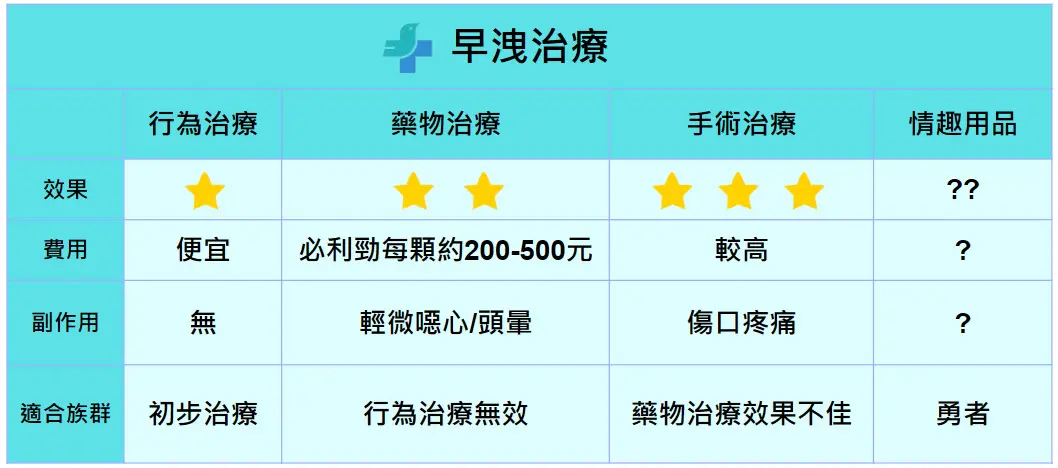
So how can it be improved? Keep reading to find the treatment that’s right for you! We’ll introduce conservative treatments, behavioral therapy, and surgical treatments one by one.
Conservative treatment: Improve premature ejaculation without surgery
●Oral medication to delay ejaculation (Priligy) → Acts on the central nervous system to extend ejaculation time by about three times
-Pros: Few side effects; works quickly and well
-Cons: Only works when you take it; it is a “prescription medication that you pay for out of pocket” and must be prescribed by a doctor
●Numbing spray/anesthetic cream → Apply it to the glans. After it is absorbed through the skin, clean off any excess anesthetic to effectively reduce sensitivity
-Pros: Few side effects; works quickly and well, and the amount of anesthetic can be adjusted
-Cons: Only works when applied; your partner may feel numb
●Behavioral training → Gradual training to reduce sensitivity (for example: the squeeze technique/Kegel exercises/massage)
-Pros: Few side effects; progress is gradual
-Cons: Results vary, and it takes several weeks of training to see results
For example: Taiwan’s well-known sex therapist, Tong Song-Zhen, developed the figure-eight massage technique, which you can try at home. Remember to apply lubricant to avoid injury from friction to your penis
Surgical treatment: Addressing the root cause of structural sensitivity
If you clearly feel that you’re “really too sensitive,” or you’ve tried the methods above and they still haven’t worked, you can consider the following surgical treatments:
1. Circumcision
●If you have a long foreskin or the glans has rarely been exposed to the outside → Circumcision may reduce sensitivity
●Improves odor and hygiene issues
●Improves appearance
●Recovery takes about 4 weeks
2. Frenulum removal
●A short “frenulum” can cause discomfort from pulling
●After treatment, thrusting feels smoother, without pulling or stinging
●Reduces sensitivity
●Quick recovery, about 1–2 weeks
3. Dorsal neurectomy
●Some people are born with more nerves and greater sensitivity;identify the dorsal nerves of the penis and selectively remove some of them
●Preserves sexual desire and the ability to ejaculate
●The surgery takes longer
●Recovery takes about 4–6 weeks
4. Glans augmentation
●Inject a small amount of hyaluronic acid beneath the skin of the glans to reduce sensitivity while making the glans fuller
●Allogeneic dermal matrix powder injected into the corpus cavernosum of the glans
●Minimally invasive + a fuller appearance, for improved aesthetics
●Quick recovery, about 1–2 weeks; injections can be repeated
※The above procedures can be combined or performed individually
With so many options, how should I choose?
The simplest and least expensive option: buy a bottle of lubricant and try behavioral therapy at home. If the results aren’t good, see a urologist and try medication. If you’re still not satisfied after trying the above methods, you can discuss surgical treatment with your doctor.
In conclusion
Premature ejaculation is not a defect; it’s a condition that can be improved
It’s not that you “can’t do it”—you just “haven’t learned to control it yet.” Once you’re willing to face the issue, there are actually many options for improvement, and they work well.
Many people find that after addressing it, not only do they feel more confident in their sex lives, but their relationships with their partners also improve and become more stable.

本文醫療審訂
Dr. Chu Hsin-Cheng
Dr.Chu Hsin Cheng
A urology specialist who focuses on male intimate cosmetic surgery and the diagnosis and treatment of sexual dysfunction. With over 10 years of clinical experience, he advocates evidence-based, easy-to-understand patient education to support every man. Professional × compassionate × discreet, helping you regain your confidence.